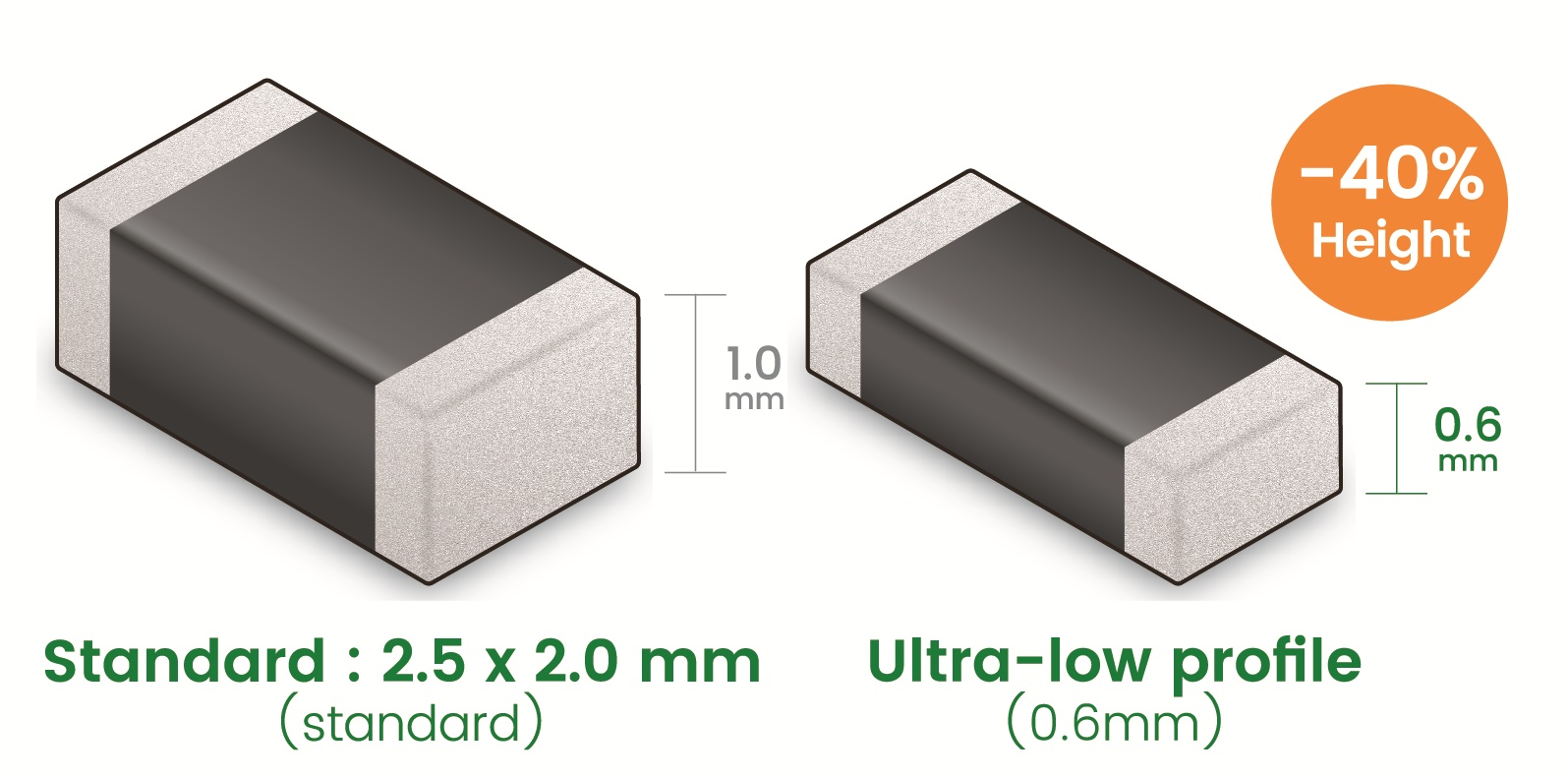
Ultra thinner, Hyper power|PDLS252006 Multilayer Power Inductor
As electronic systems continue to evolve toward higher power density and smaller form factors, power management becomes increasingly critical.
In DC-DC converters, designers must achieve stable output, high efficiency, and thermal reliability—within increasingly limited space.
The PDLS252006 series is developed to meet this challenge, offering a balanced solution between ultra-thin size, current capability, and electrical stability.
The Role of Inductor in Power Systems
An inductor is fundamentally defined by its ability to resist changes in current:
Voltage = L × (dI/dt)
This means:
- Higher inductance slows current variation
- Lower inductance enables faster response
In practical circuits, an inductor serves as:
- An energy storage element
- A current smoothing component
- A stability control element in power systems
These characteristics make inductors essential in switching power supplies.
These characteristics make inductors essential in switching power supplies.
A DC-DC converter transforms one DC voltage level into another, such as:
- 48V → 3.3V (telecom systems)
- 12V → 5V (industrial or USB applications)
- Battery → regulated voltage for ICs
The conversion process relies on:
- High-speed switching devices (MOSFETs)
- Inductors and capacitors for energy transfer
- PWM control for voltage regulation
Within this system, the inductor directly affects
- Output voltage stability
- Current ripple Conversion efficiency
- Thermal performance
PDLS252006 Design Concept
The PDLS252006 series is engineered with a clear objective:
Deliver practical power performance within an ultra-thin footprint
1. Ultra-Thin Structure (0.6 mm Max.)
Designed for compact applications such as:
- Smartphones
- IoT modules
- Wearable devices
2. Strong Current Capability
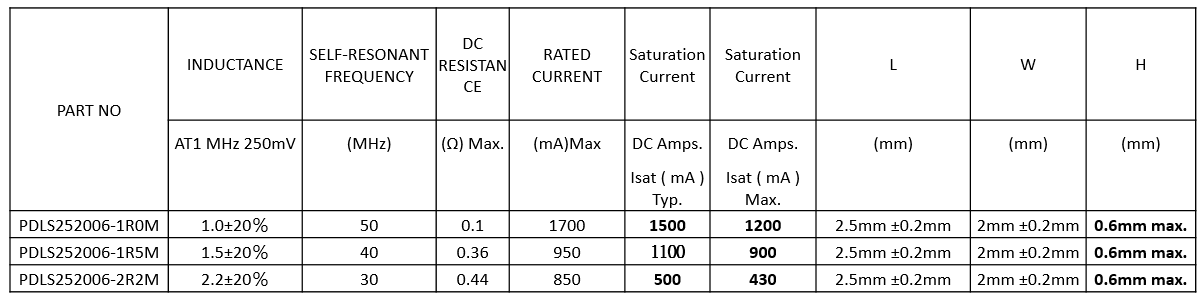
For example, at 1.0 μH:
- Rated current: 1700 mA
- Saturation current (Isat): 1500 mA (Typ.)
Ensuring stable operation under real load conditions.
3. Low DC Resistance (DCR)
Enables:
- Reduced conduction loss
- Higher efficiency
- Lower temperature rise
4. High-Frequency Stability
Maintains stable electrical performance in switching environments.
Typical Applications
The PDLS252006 series is suitable for:
- DC-DC converters
- Mobile and portable electronics
- IoT and wireless modules
- Communication equipment
- Embedded power systems
Engineering Considerations
When selecting a power inductor, engineers typically evaluate:
1. Inductance vs. Current Capability
Higher inductance reduces ripple but may limit current handling.
2. DCR vs. Efficiency
Lower DCR reduces power loss and heat generation.
3. Isat vs. Load Conditions
Isat must exceed operating current to ensure stable performance.
The PDLS252006 series provides a well-balanced solution across these parameters.
Conclusion
Rather than optimizing a single parameter, the PDLS252006 series delivers a practical and application-oriented solution:
- Ultra-thin structure
- Sufficient current capability
- Stable power performance
Ultra thinner, Hyper power.
We introduce the features—but ultimately, performance is defined by data.
Full specifications are available here:
please contact us for sample